

FTIR Analysis Services in Blackburn
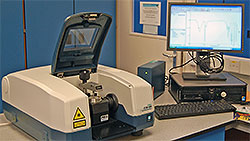 FTIR Fourier Transform Infrared Spectrophotometry – FTIR analysis – is a highly sensitive technique, particularly for identifying organic chemicals in a whole range of situations, including solid, liquid and gas samples. FTIR can also be used to characterise some inorganic compounds, and it may be used to identify both pure compounds and simple mixtures. LPD Lab Services is an independent, UKAS-accredited (2766), ISO 17025 analytical laboratory based in Blackburn, East Lancashire, and our FTIR and FTIR microscopy capabilities support routine chemical analysis, quality control and contamination investigation for clients across the UK.
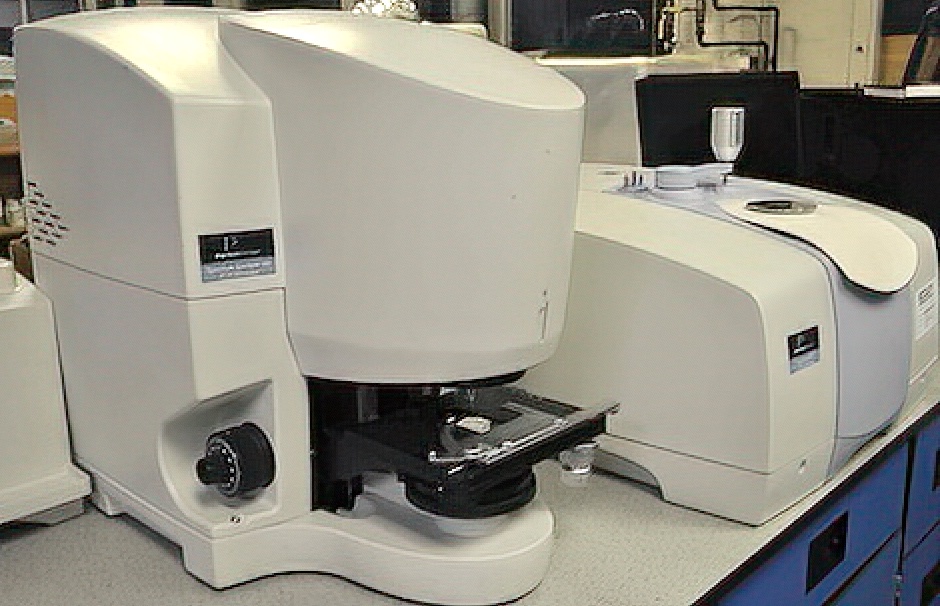
Our instruments also feature an FTIR Microscope that enables the collection of FTIR spectra of extremely small samples to examine the composition of individual particles and materials – in effect, small visible and microscopic particle chemical analysis by FTIR microscopy. Examples include paints, adhesives, resins, polymers, rubbers, coatings, pharmaceuticals and additives used in food and other consumer goods. It is a particularly useful tool in isolating and characterising organic contamination.
How FTIR Analysis Identifies Organic Chemicals and Contaminants
Every material absorbs infrared radiation at characteristic frequencies, so an FTIR spectrum acts as a molecular fingerprint that can be matched against reference libraries to establish what a sample is made of. That makes FTIR analysis a first-choice technique for routine qualitative and quantitative FTIR analysis of unknown and known materials alike, whether the sample is a solid, a liquid or a gas. 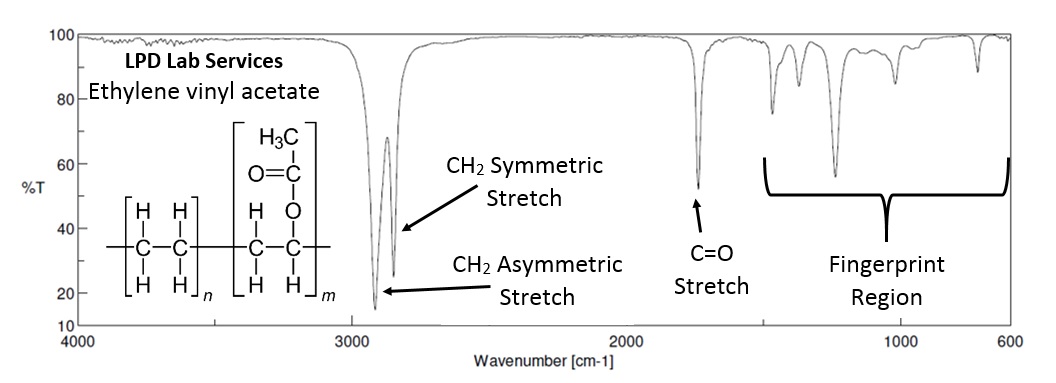 A heated stage accessory extends the technique into temperature-dependent studies of materials, revealing how a spectrum changes as the sample is heated and what that implies for processing, service life and failure.
FTIR Microscopy for Single-Particle and Micro-Sample Analysis
By coupling infrared spectroscopy with optical magnification, the FTIR microscope collects spectra from areas far too small for conventional sampling, so the chemical identity of a single particle or fibre can be established directly, without any separation step. In short, it provides Small visible and microscopic particle chemical analysis by FTIR microscopy.
Polymer, Rubber and Coating Identification with FTIR
Polymers, rubbers and organic coatings have strong, well-characterised infrared absorptions, so FTIR is the workhorse technique for identifying them and for tracking how they change with time and use. Typical applications of FTIR and FTIR microscopy include:
- Identification of polymers and polymer blends.
- Assessment of changes of polymers and rubbers due to both ageing and environmental degradation like oxidation and hydrolysis.
- Analysis of adhesives, coatings and adhesion promoters or coupling agents.
 Analysis of resins, composite materials and release films.
- FTIR identification of rubbers and filled rubbers coupled with pyrolysis GC-MS.
- Determination of degrees of crystallinity in polymers like LDPE and HDPE.
- Comparative chain lengths in organics.
- Extent of thermal, UV or other degradation or depolymerisation of polymers and paint coatings.
- Cross-sectional analysis and imaging of different primer, top coat and clearcoat paint layers looking for missing layers, interface contaminants combined with SEM / EDX of filler materials.
Pharmaceutical, Food and Medical Device FTIR Testing
From low-volume quality control to contamination investigations, FTIR serves the pharmaceutical, medical device, food and consumer goods supply chains:
- Low-volume quality control and pharmacopoeia testing.
- Contaminants in pharmaceutical APIs, WFI water for injection and blood products.
- Checks for localised attack by antiseptic chemical products and wipes on rubbers and plastics in hospitals and the medical device industry.
- Quantitative analysis of ethanol in hand sanitiser using a fixed path length liquid cell.
Organic Contamination, Cleaning Residue and Surface Analysis by FTIR
Where a surface has been contaminated, cleaned or coated, FTIR can detect and identify the residues left behind – typically indirectly, through the organic films they deposit. Combined with complementary surface techniques, this covers:
- Indirect identification of trace organic contaminants on surfaces.
- Thin film analysis of organic coatings and oxide thicknesses on metals such as aluminium.
- Analysis of stains and surface blemishes residual from cleaning and degreasing processes combined with optical microscopy, SEM / EDX, XPS, SIMS and FTIR microscopy techniques.
- Solvent extractions of leachables or contaminants, plasticisers, mould release agents and weak boundary layers coupled with XPS surface chemical analysis techniques.
- FTIR analysis of unknown solvents, cleaning agents and detergents combined with GC-MS.
Microplastics, Dust and Environmental FTIR Analysis
FTIR microscopy and gas-cell FTIR extend the technique from the bench to the environment, from drinking water to the air we breathe:
- FTIR microscopy of microplastics in freshwater, sea water, soil and wastewater with pyrolysis GC-MS.
- Identifying specific fibres and particles in inhalable dust by FTIR microscopy and SEM / EDX.
- Analysis of gaseous samples using a gas cell for headspace analysis or environmental monitoring.
FTIR Reverse Engineering of Unknown Compounds and Formulations
Difficult questions rarely need a single technique, so FTIR is routinely combined with complementary methods to give an unambiguous answer:
- FTIR analysis and reverse engineering of unknown compounds and formulations, particularly when combined with GC-MS.
- Evaluation of chemical reaction pathways, rates of reaction and assessment of reaction completion.
- Analysis and characterisation of antimicrobial coatings and polymers by FTIR, pyrolysis GC-MS and XPS.
Frequently Asked Questions About FTIR Analysis
What can FTIR analysis identify?
FTIR analysis identifies organic chemicals in solid, liquid and gas samples, both pure compounds and simple mixtures, and can also characterise some inorganic compounds. It is used for polymers, rubbers, paints, adhesives, resins, coatings, pharmaceuticals, food and consumer goods additives, and for isolating and characterising organic contamination.
What is FTIR microscopy used for?
FTIR microscopy couples infrared spectroscopy with optical magnification, enabling the collection of FTIR spectra of extremely small samples. It is used to examine the composition of individual particles and materials, including small visible and microscopic particles, specific fibres in inhalable dust and microplastics in water, soil and wastewater.
Can FTIR identify unknown materials or contaminants?
Yes. Unknown solvents, cleaning agents and detergents can be identified by FTIR analysis, particularly when combined with GC-MS, and unknown compounds and formulations can be reverse engineered. Trace organic contaminants on surfaces can be identified indirectly, and stains or surface blemishes from cleaning and degreasing processes can be analysed in combination with optical microscopy, SEM/EDX, XPS, SIMS and FTIR microscopy.
Does FTIR work on solids, liquids and gases?
Yes. FTIR handles solid, liquid and gas samples; gases are measured using a gas cell for headspace analysis or environmental monitoring. Thin films of organic coatings and oxide layers on metals can also be analysed, and temperature-dependent studies are available using a heated stage accessory.
Which sample types can be analysed by FTIR?
FTIR and FTIR microscopy cover polymers and polymer blends, rubbers and filled rubbers, paints, adhesives, resins, composite materials, release films, coatings, pharmaceuticals, WFI water for injection, blood products, hand sanitiser, inhalable dust, microplastics in freshwater, sea water, soil and wastewater, and unknown solvents, cleaning agents and detergents.
Request a Quote for FTIR Analysis
If you need to identify an unknown material, trace organic contamination, characterise a polymer failure or check a product for contamination, our scientists in Blackburn, East Lancashire can help. Send us the sample, particle deposit or coating cross-section, or ask for advice on the right combination of FTIR and complementary techniques. LPD Lab Services is an independent, UKAS-accredited (2766), ISO 17025 analytical laboratory based in Blackburn, East Lancashire, providing FTIR analysis and FTIR microscopy to clients across the UK – request a quote today.