
Particle Contamination Identification
 Particle contamination identification is a specialist service at LPD Lab Services, an independent UKAS-accredited analytical laboratory based in Blackburn, East Lancashire. Foreign body and particulate contamination can appear unexpectedly, mixed or buried in solid materials, plus within liquids and gases. Isolating the particle contamination or foreign body, then characterising and identifying the composition of the particle found in products or processes, can usually yield a likely source for the particle or foreign body. Once the source of the particulate is known, elimination or control of the contamination or foreign body becomes substantially easier.
How We Identify Foreign Body and Particle Contamination
All particles and foreign particulate matter (FPM) have characteristic properties such as shape, size and chemistry which assist in identification. At LPD Lab Services, an independent laboratory founded in 2009 on the Philips Electronics site in Blackburn, we have extensive experience in identifying and characterising particulate contamination and foreign bodies, both from our historic own manufacturing on-site and from performing this type of work for external customers. We combine SEM / EDX – a scanning electron microscope coupled with energy-dispersive X-ray analysis – with optical microscopy to provide analytical tools for unambiguously identifying such particles. The technique is frequently coupled with FTIR or GC-MS to identify organic contamination.
Common Sources of Particulate Contamination
Contamination particles can have many sources, for example metals and alloys, biological matter (skin, hair, etc.), polymers, water systems, filtration, building dusts, cleanrooms and medical devices, to name but a few. In regulated environments such as cleanrooms, medical device and pharmaceutical manufacturing, even a single foreign body can trigger a product investigation. Early, accurate particle identification is therefore critical, because it points directly to the process or material responsible, so the contamination can be eliminated or controlled at source.
Sample Types for Particle Contamination Analysis
We can perform this work on virtually any sample type, including:
- Liquid samples – suspended particles, sediment, residues, contaminants and precipitates
- Filters and membranes
- Product surfaces such as rubber, ceramic, glass, catalysts and building materials
- Particles buried within product materials such as laminates, plastic films, glass, ceramics, inclusions in metals and alloys
- Contamination on metals, alloys, rust or corrosion
- Foreign bodies within regulated products in cleanrooms, medical device or pharmaceutical environments
- Debris, particles and fibres in food, drink and liquids
- Data centre failure, power disruption, contamination and corrosion investigations
Particle Contamination Identification Across UK Industries
LPD Lab Services has seen samples from a wide number of sectors, including – automotive, aerospace, food, medical device, healthcare, pharmaceutical, Oil & Gas, construction, FMCG, plumbing, paints and coatings. Whether the foreign body is a rust particle in a chemical tank or a charred pollen grain on an electron gun, the workflow is the same: isolate, characterise, identify the source and recommend a corrective action.
Particle Identification Case Examples from the Lab
Examples of particulate identification work are shown below.
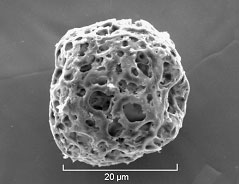 The image shows a particle, or foreign particulate matter (FPM), on the surface of a metal grid on an electron gun from a cathode ray tube. The gun had failed with insulation leakage between adjacent gun lenses, and during dismantling of the gun a few fine particles were seen in the gap between these grids.
A contaminant particle was analysed in the SEM and this showed it to contain mainly carbon, with small amounts of oxygen and sulphur.
From the analysis and appearance of the foreign particle, it was identified as either soot or a charred pollen grain. Speaking to the customer, it transpired that the gun had been dried in an oven at 140°C after a washing process. The solution to the problem was to fit a filter to the fan system to prevent ingress of airborne contamination during drying.
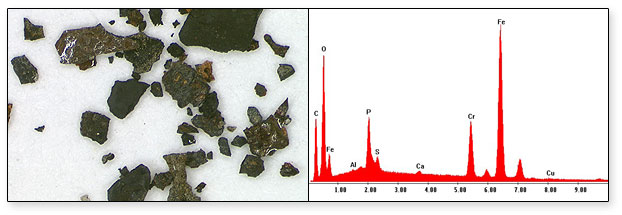
Particulate matter analysis by SEM of oxidised steel particles found in a chemical tank, together with EDX analysis showing the chemical information. The particles were identified as rust from defective pipework.
Frequently Asked Questions About Particle Contamination Identification
What is particle contamination and how is it identified?
Particle contamination (also called foreign particulate matter, or FPM) is the presence of unwanted particles or foreign bodies in or on a product, or within a process. Every particle has characteristic properties such as shape, size and chemistry, which assist in identification. We isolate the particle and characterise its composition using SEM-EDX and optical microscopy, adding FTIR or GC-MS where the source is an organic material.
How does SEM-EDX analysis identify a foreign particle?
The scanning electron microscope (SEM) images the particle at high magnification to reveal its shape and surface detail, while EDX determines its chemical composition. In one investigation the analysis showed a particle to contain mainly carbon, with small amounts of oxygen and sulphur, and from its appearance it was identified as a charred pollen grain.
What sample types can be tested for foreign body contamination?
We can perform the work on virtually any sample type, including liquid samples (suspended particles, sediment, residues and precipitates), filters and membranes, product surfaces, particles buried within laminates, plastics, glass, ceramics or metals, and foreign bodies within regulated products in cleanrooms, medical device or pharmaceutical environments.
Can you identify the source of a contaminant in a product or process?
Yes. Once the composition of a particle or foreign body is established, it can usually be matched to a likely source, such as rust from defective pipework or airborne contamination ingested during a drying process. Knowing the source makes elimination or control of the contamination substantially easier.
Request a Quote for Particle Contamination Identification
If you are investigating a foreign body or particulate contamination issue, please contact us today to discuss your particle characterisation needs in detail. LPD Lab Services is an independent, UKAS-accredited analytical laboratory in Blackburn, East Lancashire, providing particle contamination identification to clients across the UK.